Quick answer
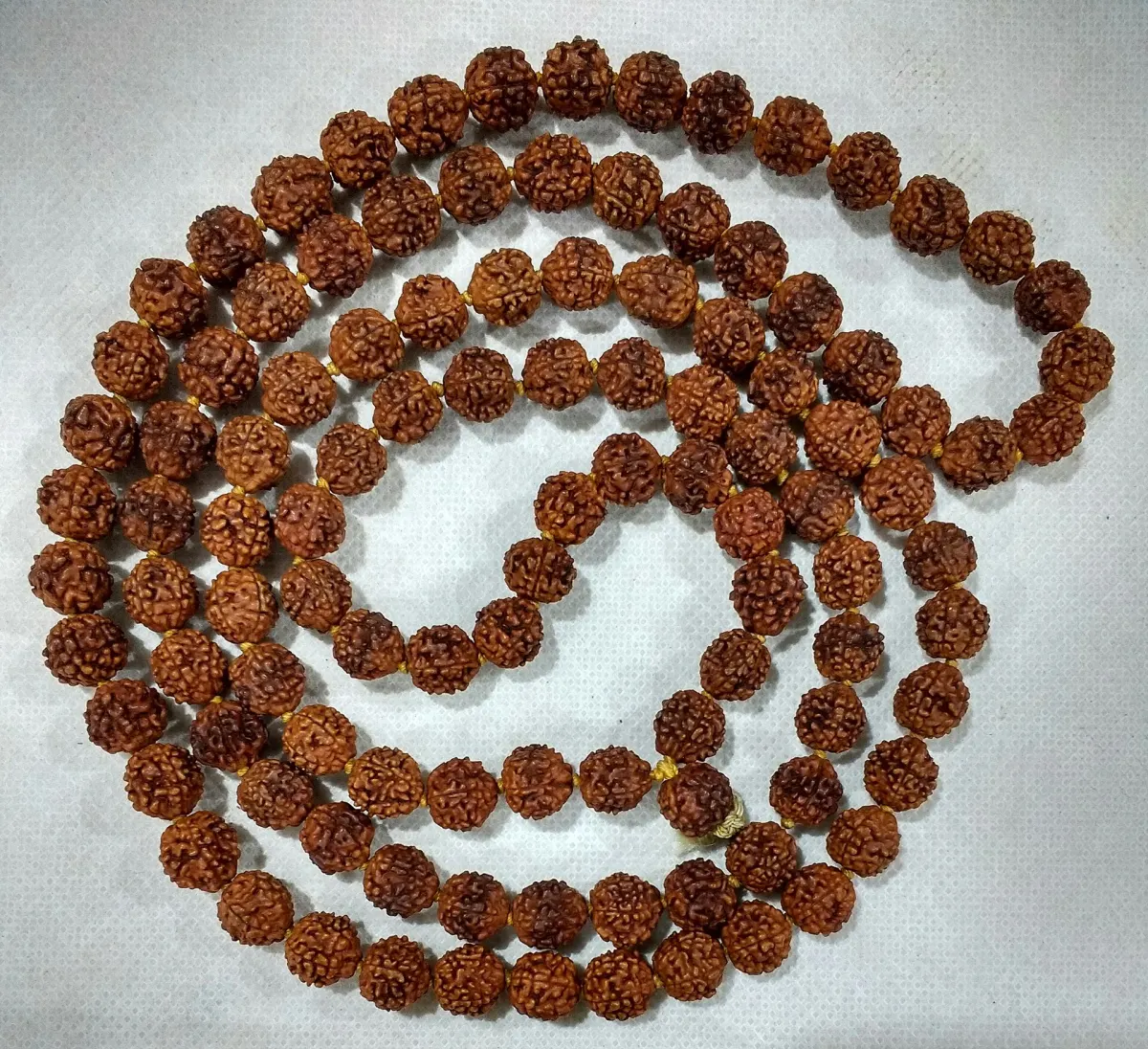
A japamala usually has 108 counting beads plus one larger bead, the sumeru or guru bead, which is not counted. The number 108 is sacred across Hindu, Buddhist and Jain traditions, each with its own reasons, from the 108 Upanishads of the Muktika canon to the 108 feelings of Theravada teaching.
Ask why a mala has 108 beads and you will hear several answers, each of them true. The number is sacred in many traditions at once, and each arrived at it by its own road. A Shaiva and a Jain can hold the same mala and count the same 108 for entirely different reasons.
What 108 means in each tradition
| Tradition | Where 108 appears |
|---|---|
| Hindu, Shaiva | The principal attendants of Shiva, the Shivaganas, are 108; Lingayats and other Shaivas use malas of 108 beads |
| Hindu, Vaishnava | In Gaudiya tradition, Krishna had 108 gopis in Vrindavan, whose names are recited on a mala of 108; Sri Vaishnavas revere 108 Divya Desams, the temples of Vishnu |
| Hindu, Shakta | There are 108 Shakta pithas, sacred places of the Goddess |
| Hindu, Vedanta | The Muktika canon counts 108 Upanishads |
| Jain | 108 is the number of ways karma flows in: 4 passions × 3 instruments (mind, speech, body) × 3 stages × 3 ways of acting |
| Theravada Buddhist | 6 senses × 3 kinds of feeling × 2 sources × 3 times gives 108 feelings |
| Tibetan Buddhist | Malas usually have 108 beads, matching the 108 volumes of the Kangyur, the Buddha's words |
| Japanese Buddhist | Temple bells ring 108 times at the new year, one for each earthly temptation |
Turning a mala of 108 is, on one reading, passing through every way the mind meets the world, once.
The Jain and Theravada answers are worth pausing on. Neither says 108 is sacred because it is mysterious; both arrive at it by counting the ways the mind meets the world. Turning a mala of 108 is, on that reading, passing through every one of them once.
The number itself
108 is also a satisfying number to count with. It divides evenly in many ways: by 2, 3, 4, 6, 9, 12, 18, 27, 36 and 54. That is why smaller malas of 54 or 27 beads exist: two rounds of 54 or four of 27 make one full 108. It is also 1 × 2² × 3³, which some people find pleasing as a pattern of one, two and three.
Why there is a 109th bead
The 108 counting beads are joined by one more, larger bead: the sumeru, also called the guru bead or mother bead. It is where a round begins and ends, and it is not counted. Instead of crossing it, you turn the mala around and go back. The sumeru bead guide explains this in full.
Some Tibetan malas add three smaller marker beads that divide the 108 into four sections of 27, so you can tell at a touch how far through a round you are.
What 108 means for your practice
In practice, 108 is a unit: one mala. Daily practice is counted in malas, and vows in multiples of them. 10,800 is exactly 100 malas, a number that recurs in tradition, and sava lakh is 1,158. When you are ready for a longer vow, sava lakh jaap explains the best known, and the sankalpa calculator turns any total into malas a day.
Frequently asked questions
Why do some malas have 54 or 27 beads?
They are factors of 108. Two rounds of a 54-bead mala, or four rounds of a 27-bead mala, make a full count of 108. Smaller malas are easier to carry or wear on the wrist.
Is the sumeru bead counted in the 108?
No. The sumeru, or guru bead, is the 109th bead. Counting begins and ends on the beads next to it.
Is 108 the same in Hinduism and Buddhism?
The number is the same and both use malas of 108 beads, but the reasons differ. Hindu traditions point to the 108 Upanishads or the 108 attendants of Shiva; Buddhists to the 108 feelings or the 108 volumes of the Kangyur.
Do I have to chant exactly 108 times?
One full round of the mala is 108, and that is the usual unit. Your teacher or tradition may give you a different number for a particular mantra. See how many times to chant a mantra.
Sources
Begin your next mala.
Japo is a japa counter that feels like the real thing. Pull a bead with your thumb, feel a soft tick, and pick up exactly where you stopped. Counting, history and goals are free.