Quick answer
Sava lakh jaap means 1,25,000 repetitions of one mantra. At 108 to a mala that is 1,158 malas. In 40 days it takes 29 malas a day; at 11 malas a day it takes 106 days. Most people take a sankalpa first, then chant a steady number of malas each day until the total is reached.
Sava lakh is one of the best-known counts in japa. People take it for a Mahamrityunjaya, Gayatri or Hanuman mantra, for a family occasion, or as a personal vow. The number sounds daunting, but broken into malas and days it becomes a plan you can keep.
सवा लाखHow much is sava lakh jaap?
Sava means one and a quarter, and a lakh is 1,00,000. So sava lakh is 1,25,000 repetitions of the same mantra.
| Unit | Sava lakh |
|---|---|
| Repetitions | 1,25,000 |
| Malas of 108 | 1,158 (1,157 malas fall 44 short) |
| Malas if your tradition counts 100 a mala | 1,250 |
How many days does it take?
That depends on how many malas you chant a day. Here are common plans, counting 108 to a mala.
| Malas a day | Days to finish | Time a day at about 5 minutes a mala |
|---|---|---|
| 11 | 106 days | About 55 minutes |
| 16 | 73 days | About 1 hour 20 minutes |
| 21 | 56 days | About 1 hour 45 minutes |
| 29 | 40 days | About 2 hours 25 minutes |
| 51 | 23 days | About 4 hours 15 minutes |
| 108 | 11 days | About 9 hours |
Five minutes a mala is only a guide. A short mantra may take two minutes; a long one like the Mahamrityunjaya can take far more. Time one mala of your own mantra and put your numbers into the sankalpa calculator.
Three decisions that decide whether you finish
The mantra. If a guru or your family has given you one, that is the mantra. The length matters more than people expect: sava lakh of Ram is a few weeks of evenings; sava lakh of the Mahamrityunjaya is months. The mantra list has the 27 that come with Japo.
The daily number. Choose the malas a day you can keep on a tired, travelling, unwell day, not on your best one. A vow that needs three good hours every day tends to break in the second week. Extending the days is always better than rushing the mantra. If you are finishing by a fixed date, you are doing an anushthan.
How you will keep the total. Over 40 or 100 days, a notebook gets skipped, a sum is added wrong, or you cannot remember whether the last round of the night was counted. Decide before day one where the running total lives, and add to it the moment each sitting ends.
Keeping count across 1,25,000
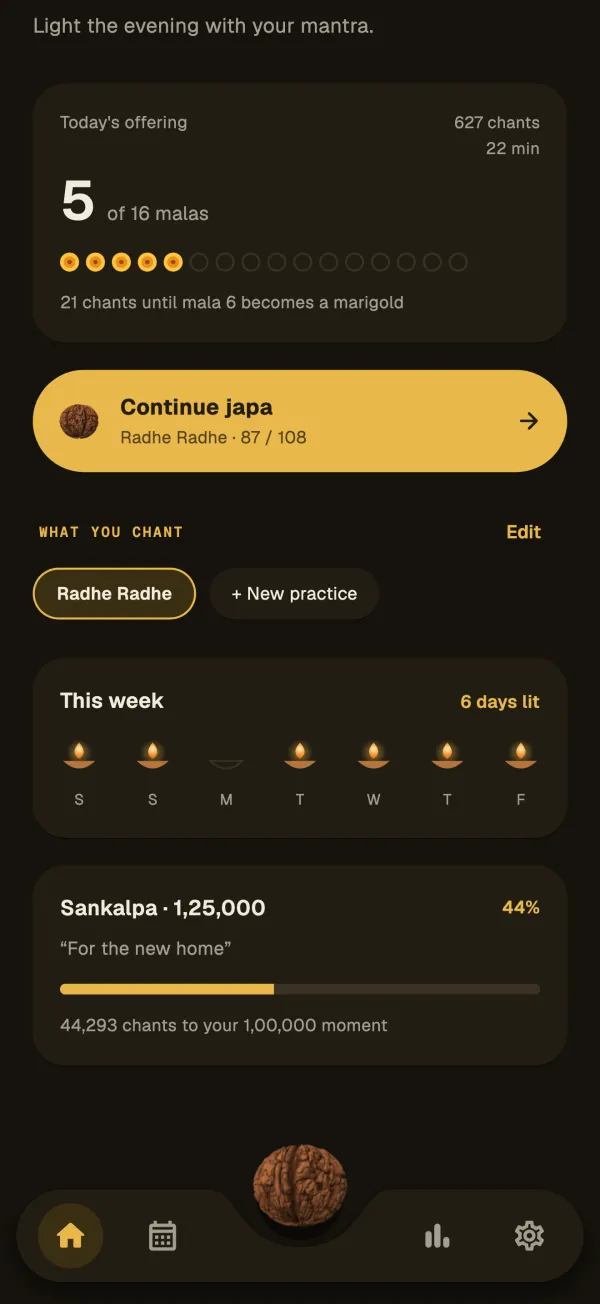
Tibetan practitioners solved the bookkeeping with their malas: counter beads on side cords for rounds and tens of rounds, and a small charm, the bhum counter, that moves once for every 10,800. A phone can carry the same load. In Japo, you set the sankalpa once, with the reason you took it, and every bead you count adds to it. The home screen shows how far you have come, and when you set an end date, Japo shows what it means per day: about 3,125 a day, or 29 malas, over 40 days.
Frequently asked questions
Sawa lakh jaap kitna hota hai?
Sava lakh jaap 1,25,000 mantra hota hai, yaani 108 manke ki 1,158 malaen. Sava lakh is 1,25,000 repetitions, which is 1,158 malas of 108.
How many malas a day for sava lakh in 40 days?
29 malas a day. That is 3,132 repetitions a day, which finishes 1,25,000 on the 40th day.
Can I chant sava lakh jaap of any mantra?
The count can be taken for any mantra. Whether a particular mantra suits a particular purpose is a question for your tradition or teacher. Popular choices include the Mahamrityunjaya mantra, the Gayatri mantra and Om Namah Shivaya.
What if I miss a day during sava lakh jaap?
Carry on the next day and add the missed malas over the days that remain, or extend the end date. The vow is the total, not a perfect streak.
Do I have to count 108 or 100 for each mala?
Follow your tradition. Counting all 108 gives 1,158 malas; counting 100 a mala, with 8 as extra, gives 1,250.
Sources
Begin your next mala.
Japo is a japa counter that feels like the real thing. Pull a bead with your thumb, feel a soft tick, and pick up exactly where you stopped. Counting, history and goals are free.